
 |
 |
 |
 |
 |
 |
 |
 |
 |
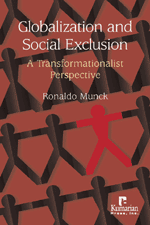
Globalization and Social Exclusion: A Transformationalist Perspective
Ronaldo MunckWe inhabit a world of consequences and butterfly effects. When global economies integrate, what disintegrates as a result? The answer, Ronaldo Munck contends, is social equality. This is the first book to view globalization through the lens of social exclusion--defined as all the ways in which people are prevented from obtaining the necessities of life.
To illustrate how globalization deepens the existing inequities of race, place, gender, and class, in both the global North and South, the author highlights disparities in living conditions; the feminization of poverty and the global sex trade; the effects of racism, migration, and multiculturalism; and the formation and political manifestations of social class.
He boldly develops a politics and ethics of transformation to move us beyond social exclusion--even beyond mere social inclusion. He provides us with the tools to transform society from within, creating a more democratic and just global order.
Order this book now from Kumarian Press Online
Globalization and Health
Richard L. Harris and Melinda Seid, Editors
This international collection of essays on globalization and health examines the global health issues associated with the economic, technological, political, social, cultural and environmental effects of globalization. The essays analyze the complex linkages between globalization and health, the health effects of globalization at all levels (global, national, and local), and the policy and institutional responses associated with the health consequences of globalization.
Brill Academic Publishers
ISBN 90 04 14145 6
Paperback (xii, 276 pp.)
List price: EUR 41.- / US$ 59.-This book is part of Brill's Series on International Studies in Sociology and Social Anthropology
Richard Harris is Professor of Global Studies and World Languages and Cultures at California State University, Monterey Bay. He has written extensively on political, economic and social issues in Africa, Asia and Latin America as well as on globalisation, revolutionary change, socialism and democracy. He is a coordinating editor of Latin American Perspectives and the editor of the Journal of Developing Studies.
Melinda Seid is Professor and Coordinator of the Health Sciences Progam in the Department of Kinesiology and Health at California State University, Sacramento. She is a specialist in health administration and program evaluation and has carried out research, consulting and written on various health issues in the United States, the Russian Far East and Cuba.
Harris and Seid are the editors of a previous Brill publication on globalization entitled Critical Perspectives on Globalization and Neoliberalism in the Developing Countries (Brill, 2000).
Order this book now from Brill Academic Publishers
Globalizing Democracy and Human Rights
by Carol C. GouldIn her new book, Carol Gould, the author of the highly regarded and successful Rethinking Democracy, addresses the fundamental challenge of democratizing globalization, that is, of finding ways to open transnational institutions and communities to democratic participation by those widely affected by their decisions.
The book develops a framework for expanding such participation in crossborder contexts, arguing for a strengthened understanding of human rights that can confront worldwide economic and social inequalities. It also introduces a new role for the ideas of care and solidarity at a distance. Reinterpreting the idea of universality to encompass a multiplicity of cultural perspectives, the author takes up a number of applied issues, including the persistence of racism, the human rights of women, the democratic management of firms, the use of the Internet to enhance political participation, and the importance of empathy and genuine democracy in understanding terrorism and responding to it.
Clearly and accessibly written, this major new contribution to political philosophy will be of special interest to professionals and graduate students in philosophy, political science, women’s studies, public policy, and international affairs, as well as anyone who wants to more fully comprehend the dilemmas of a globalized world.
Carol C. Gould is Professor of Philosophy and Government and Director of the Center for Global Ethics at George Mason University.
Order this book from Cambridge University Press.
Globalization or Empire?
by Jan Nederveen PieterseIn this smart and concise examination of the trends driving contemporary globalization, Jan Nederveen Pieterse argues that the United States' pursuit of global primacy is based upon a complex melding of neoliberal economics and hegemonic pursuits.
Do alternate capitalisms offer viable alternatives to the American way? Globalization or Empire? looks at globalization with acuity and thoughtfulness and uncovers its underlying dramas.
Jan Nederveen Pieterse is professor of sociology at the University of Illinois, Urbana-Champaign, co-editor of the Review of International Political Economy and author of Globalization and Culture and Empire and Emancipation. Read more...
Order this book from Routledge
Transnational Conflicts: Central America, Social Change, and Globalization
by William I. Robinson
Reviewed by Jerry HarrisWilliam Robinson is emerging as a major theorist on globalization, with particular expertise on Central and Latin America. His latest work, Transnational Conflicts combines innovative theoretical insights with a detailed empirical study of Central America. Any argument that positions U.S. hegemony at the center of a nation/state imperialist system will have to answer Robinson’s analysis of transnational capitalism.
What makes Robinson’s approach so unique is that he takes his argument into the heart of what most observers consider the backyard of U.S. imperialism, Central America. If any region of the world is under U.S. hegemony many would list the countries of this region: Guatemala, Honduras, El Salvador, Nicaragua and Costa Rica.
Order this book from Amazon.com
A Theory of Global Capitalism: Production, Class, and State in a Transnational World
by William I. RobinsonIn this book, sociologist William I. Robinson offers a theory of globalization that follows the rise of a new capitalist class and a transnational state. Growing beyond national boundaries, this new class comprises a global system in which Japanese capitalists are just as comfortable investing in Latin America as North Americans are in Southeast Asia. Their development of global, interconnected industries and businesses make them drivers of world capitalism.
Robinson explains how global capital mobility has allowed capital to reorganize production worldwide in accordance with a whole range of considerations that allow for maximizing profit making opportunities. As a result, production systems that were once located in a single country have been fragmented and integrated externally into new globalized circuits of accumulation. What this means, however, is not simply that factories are located overseas where labor might be cheaper, but rather that the whole production process is broken down into smaller parts and each of those parts moved to a different country, depending on where investment might be highest. Yet at the same time, this worldwide decentralization and fragmentation of the production process has taken place alongside the centralization of command and control of the global economy in transnational capital. Read more...
Class Theory and History
by Steven Resnick and Richard WolffClass Theory and History takes an ambitious and ground-breaking look at the entire history of the Soviet Union and presents a new kind of analysis of the history of the USSR: examining its birth, evolution, and death in class terms. Utilizing the class analytics they have developed over the last three decades, Resnick and Wolff formulate the most fully developed economic theory of communism now available, and use that theory to answer the question: did communism ever exist in the USSR and if so, where, why and for how long? Read more...
Economic Governance in the Age of Globalization
by William TabbRapid growth, reduced poverty, and stable societies: the announced benefits of the world economy celebrated by neoliberal proponents of "the Washington consensus" have failed to materialize. What does this failure mean for future world order and the U.S. role as global hegemon? Addressing this crucial question, William Tabb argues that global economic institutions such as the World Bank and the International Monetary Fund constitute a nascent international state for which all previous models of sovereignty, accountability and equity are inadequate. Integrating economics and political science, Tabb traces the emergence of this global state from the closing days of World War II and examines its future prospects.
Read more...
Jose Maria Sison: At Home in the World
Portrait of a Revolutionary
Conversations with Ninotchka Rosca
George W. Bush and his Administration have labeled Jose Maria Sison as a “terrorist”. Former United States Attorney-General Ramsey Clark has stated, “Those of us who are working to stop the unbridled aggression against the world that has been unleashed by the Bush White House should make every effort to defend Prof. Jose Maria Sison, and to support the Filipino people as they struggle to defend sovereignty and build peace.” Read more...Coming Soon
The Clash of Globalisations: Neo-liberalism, the Third Way and Anti-Globalisation
by Ray KielyBrill Academic Publishers (Early 2005)
Ray Kiely is Senior Lecturer in Development Studies, SOAS, University of London. His previous books include Sociology and Development: The Impasse and Beyond (1995) and Industrialisation and Development: A Comparative Analysis (1998).