
July 23, 2008

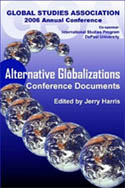
Alternative Globalizations
Edited by Jerry Harris
GSA 2006 Conference Book Cover

Alternative Globalizations contains papers from the fifth annual conference of the Global Studies Association of North America (GSA/NA), held at DePaul University in Chicago in May 2006.

The special focus of the 2006 conference was alternative developmental paths emerging mainly in global South. A number of papers examine changes occurring in Latin America, particulary in Venezuela, Mexico, Argentina, Bolivia and Brazil.

Highlights are from keynote speakers and well-known Latin American specialists Mark Weisbrot, Fred Rosen and Graciela Monteagudo.


Order this book now from Lulu.com

Back to top


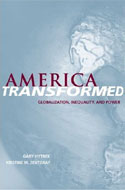
America Transformed: Globalization, Inequality, and Power
by Gary Hytrek and Kristine Zentgraf

Globalization--the interconnection of the world culturally, socially, politically, and economically--has generated intense theoretical and practical concerns. Is globalization inevitable? What are the effects of globalization on social structures and individual perceptions? What is the effect of globalization on societal level inequality? America Transformed: Globalization, Inequality, and Power examines these questions by analyzing the links among global processes and shifting patterns of stratification, inequality, and social mobility in the United States. While many texts separate discussions of macro- and micro-level processes when examining globalization, this book skillfully integrates general macro-level processes with specific reference to the micro-level effects of globalization in the U.S. Exploring the critical dimensions of inequality--class, gender, and immigration--America Transformed situates the U.S. experience within the broader global context, and fleshes out the mechanism through which global processes affect social stratification. By examining the social construction of globalization, the authors identify the key policy challenges of globalization, and some of the innovative community-based responses to social inequality. America Transformed provides powerful insights into the contested dialectical relationship between global and local forces: how globalization shapes stratification and inequality in the U.S., and how local communities attempt to mediate those changes.

Order this book from Amazon.com

Back to top


The Clash of Globalisations: Neo-liberalism, the Third Way and Anti-Globalisation
by Ray Kiely

This work addresses the politics of globalisation through an examination of neo-liberalism, the third way, and anti-capitalist responses and alternatives. It utilises a Marxist approach, not only to challenge the claims made by apologists for 'actually existing globalisation', but to explain, contextualise and problematise the rise of anti-globalisation politics. Central to the work is a critique of globalisation theory, neo-liberalism and the third way; an examination of the role of the state as an agent of globalisation, particularly the hegemonic US state; a theorisation of the nature of uneven development in the global order; and an examination of the political implications of these issues for progressive alternatives to neo-liberal globalisation.

Ray Kiely is Senior Lecturer in Development Studies, SOAS, University of London. His previous books include Sociology and Development: The Impasse and Beyond (1995) and Industrialisation and Development: A Comparative Analysis (1998).


Order this book now from Amazon.com

Back to top


Class Theory and History
by Steven Resnick and Richard Wolff

Class Theory and History takes an ambitious and ground-breaking look at the entire history of the Soviet Union and presents a new kind of analysis of the history of the USSR: examining its birth, evolution, and death in class terms. Utilizing the class analytics they have developed over the last three decades, Resnick and Wolff formulate the most fully developed economic theory of communism now available, and use that theory to answer the question: did communism ever exist in the USSR and if so, where, why and for how long? Read more...


Back to top


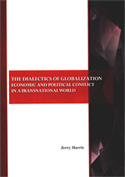
The Dialectics of Globalization: Economic and Political Conflict in a Transnational World
by Jerry Harris

Combining bold theortical analysis and careful empirical investigation Harris provides a critical framework to understand the political and economic underpinnings of globalization. In an unique historical approach the book examines how the revolution in information technologies and the break-up of the Soviet Union intertwined to present new global opportunities to reorganize capitalism as a unified world system headed by an emerging transnational capitalist class.

The book challenges the common view that nation states still define international relations, with the United States as hegemonic leader of the world system. Instead Harris offers a more complex analysis of world affairs that sees the current period as one of transition between nationally based industrial capitalism and a global system based on revolutionary methods of production and new class relationships. He argues this conflict appears in every country as national economies realigned to fit new patterns of world accumulation creating a host of political tensions within and between nations.

Read the reviews.

Order this book from Cambridge Scholars Press

Back to top


Economic Development, Education and Transnational Corporations
by Mark Hanson

Mark Hanson's incisive new monograph compares and contrasts Mexico and South Korea to answer the wider question of why some Third World nations developed economically and educationally faster than others. Hanson shows that these differences are due to the manner and intensity in which these countries employed their educational, governmental and business institutions to acquire manufacturing knowledge from transnational corporations and how they used it to grow their own local industries. Whereas South Korea looked to foreign plants as educational systems and pursued with tenacity the new knowledge they possessed, Mexico viewed them as 'cash cows' that generated wages and reduced unemployment. Hanson argues that significant economic growth and improvements in education will only occur when driven by the needs of industrialization.

Order this book now from Amazon.com

Back to top


Economic Governance in the Age of Globalization
by William Tabb

Rapid growth, reduced poverty, and stable societies: the announced benefits of the world economy celebrated by neoliberal proponents of "the Washington consensus" have failed to materialize. What does this failure mean for future world order and the U.S. role as global hegemon? Addressing this crucial question, William Tabb argues that global economic institutions such as the World Bank and the International Monetary Fund constitute a nascent international state for which all previous models of sovereignty, accountability and equity are inadequate. Integrating economics and political science, Tabb traces the emergence of this global state from the closing days of World War II and examines its future prospects.


Order this book now from Amazon.com

Back to top


Education in Globalization
by Paul Mocombe

Through a series of new and previously published essays, Education in Globalization analyzes the nature of education under American hegemony. The author interprets the role of education as an institutional or ideological apparatus for bourgeois domination. He then examines the means by which global and local social actors are educated within the capitalist world system to serve the needs of the capital (i.e. capital accumulation). The work concludes with an essay delineating what is to be done to reproduce the contemporary capitalist world system, in spite of the pending ecological crisis and the proletarianization of the masses.


Order this book now from University Press of America, Inc.


Back to top


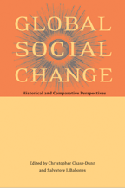
Global Social Change: Comparative and Historical Perspectives
Edited by Christopher Chase-Dunn and Salvatore J. Babones

The essays in Global Social Change explore globalization from a world-systems perspective, untangling its many contested meanings. This perspective offers insights into globalization's gradual and uneven growth throughout the course of human social evolution.

In this informative and exciting volume, Christopher Chase-Dunn and Salvatore J. Babones bring together accomplished senior sociologists and outstanding younger scholars with a mix of interests, expertise, and methodologies to offer an introduction to ways of studying and understanding global social change.


Read more about this book and order a copy today!

Back to top


Globalization and Health
Richard L. Harris and Melinda Seid, Editors

This international collection of essays on globalization and health examines the global health issues associated with the economic, technological, political, social, cultural and environmental effects of globalization. The essays analyze the complex linkages between globalization and health, the health effects of globalization at all levels (global, national, and local), and the policy and institutional responses associated with the health consequences of globalization.

Brill Academic Publishers
ISBN 90 04 14145 6
Paperback (xii, 276 pp.)
List price: EUR 41.- / US$ 59.-

This book is part of Brill's Series on International Studies in Sociology and Social Anthropology

Richard Harris is Professor of Global Studies and World Languages and Cultures at California State University, Monterey Bay. He has written extensively on political, economic and social issues in Africa, Asia and Latin America as well as on globalisation, revolutionary change, socialism and democracy. He is a coordinating editor of Latin American Perspectives and the editor of the Journal of Developing Studies.

Melinda Seid is Professor and Coordinator of the Health Sciences Progam in the Department of Kinesiology and Health at California State University, Sacramento. She is a specialist in health administration and program evaluation and has carried out research, consulting and written on various health issues in the United States, the Russian Far East and Cuba.

Harris and Seid are the editors of a previous Brill publication on globalization entitled Critical Perspectives on Globalization and Neoliberalism in the Developing Countries (Brill, 2000).

Order this book now from Amazon.com

Back to top


Globalization and Social Exclusion: A Transformationalist Perspective
by Ronaldo Munck

We inhabit a world of consequences and butterfly effects. When global economies integrate, what disintegrates as a result? The answer, Ronaldo Munck contends, is social equality. This is the first book to view globalization through the lens of social exclusion--defined as all the ways in which people are prevented from obtaining the necessities of life.

To illustrate how globalization deepens the existing inequities of race, place, gender, and class, in both the global North and South, the author highlights disparities in living conditions; the feminization of poverty and the global sex trade; the effects of racism, migration, and multiculturalism; and the formation and political manifestations of social class.

He boldly develops a politics and ethics of transformation to move us beyond social exclusion--even beyond mere social inclusion. He provides us with the tools to transform society from within, creating a more democratic and just global order.

Order this book now from Amazon.com

Back to top


Globalizing Democracy and Human Rights
by Carol C. Gould

In her new book, Carol Gould, the author of the highly regarded and successful Rethinking Democracy, addresses the fundamental challenge of democratizing globalization, that is, of finding ways to open transnational institutions and communities to democratic participation by those widely affected by their decisions.

The book develops a framework for expanding such participation in crossborder contexts, arguing for a strengthened understanding of human rights that can confront worldwide economic and social inequalities. It also introduces a new role for the ideas of care and solidarity at a distance. Reinterpreting the idea of universality to encompass a multiplicity of cultural perspectives, the author takes up a number of applied issues, including the persistence of racism, the human rights of women, the democratic management of firms, the use of the Internet to enhance political participation, and the importance of empathy and genuine democracy in understanding terrorism and responding to it.

Clearly and accessibly written, this major new contribution to political philosophy will be of special interest to professionals and graduate students in philosophy, political science, women’s studies, public policy, and international affairs, as well as anyone who wants to more fully comprehend the dilemmas of a globalized world.

Carol C. Gould is Professor of Philosophy and Government and Director of the Center for Global Ethics at George Mason University.

Order this book from Cambridge University Press.

Back to top


Globalization or Empire?
by Jan Nederveen Pieterse

In this smart and concise examination of the trends driving contemporary globalization, Jan Nederveen Pieterse argues that the United States' pursuit of global primacy is based upon a complex melding of neoliberal economics and hegemonic pursuits.

Do alternate capitalisms offer viable alternatives to the American way? Globalization or Empire? looks at globalization with acuity and thoughtfulness and uncovers its underlying dramas.

Jan Nederveen Pieterse is professor of sociology at the University of Illinois, Urbana-Champaign, co-editor of the Review of International Political Economy and author of Globalization and Culture and Empire and Emancipation. Read more...


Order this book from Routledge

Back to top


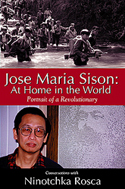
Jose Maria Sison: At Home in the World
Portrait of a Revolutionary
Conversations with Ninotchka Rosca

George W. Bush and his Administration have labeled Jose Maria Sison as a “terrorist”. Former United States Attorney-General Ramsey Clark has stated, “Those of us who are working to stop the unbridled aggression against the world that has been unleashed by the Bush White House should make every effort to defend Prof. Jose Maria Sison, and to support the Filipino people as they struggle to defend sovereignty and build peace.” Read more...


Back to top


New Departures in Marxian Theory
by Stephen Resnick and Richard Wolff

Major changes have shaken Marxism over recent decades. This collection of essays documents what has become the most original formulation of Marxist theory as it repositions itself for the twenty-first century. The authors’ new non-determinist and class-focused Marxist theory is both responsive to and critical of the other movements transforming modern social thought from postmodernism to feminism to radical democracy and the "new social movements."

In facing and trying to resolve contradictions and lapses within Marxism, Resnick and Wolff have confronted the basic incompatibilities among the dominant modern versions of Marxian theory, and the fact that Marxism seemed cut off from the criticisms of determinist modes of thought offered by poststructuralism and post-modernism as well as by some of Marxism’s greatest theorists.

Read more about this book and order a copy today!

Back to top


The Political Economy of U.S. Militarism
by Ismael Hossein-Zadeh

This wide-ranging, interdisciplinary analysis blends history, economics, and politics to challenge most of the prevailing accounts of the rise of U.S. militarism. While acknowledging the contributory role of some of the most widely-cited culprits (big oil, neoconservative ideology, the Zionist lobby, and President Bush’s world outlook), this study explores the bigger, but largely submerged, picture: the political economy of war and militarism. The study is unique not only for its thorough examination of the economics of military spending, but also for its careful analysis of a series of closely related topics (petroleum, geopolitics, imperialism, terrorism, religious fundamentalism, the war in Iraq, and the Palestinian-Israeli conflict) that may appear as digressions but, in fact, help shed more light on the main investigation.

Order this book now from Amazon.com

Back to top


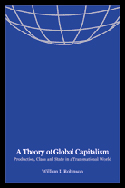
A Theory of Global Capitalism: Production, Class, and State in a Transnational World
by William I. Robinson

In this book, sociologist William I. Robinson offers a theory of globalization that follows the rise of a new capitalist class and a transnational state. Growing beyond national boundaries, this new class comprises a global system in which Japanese capitalists are just as comfortable investing in Latin America as North Americans are in Southeast Asia. Their development of global, interconnected industries and businesses make them drivers of world capitalism.

Robinson explains how global capital mobility has allowed capital to reorganize production worldwide in accordance with a whole range of considerations that allow for maximizing profit making opportunities. As a result, production systems that were once located in a single country have been fragmented and integrated externally into new globalized circuits of accumulation. What this means, however, is not simply that factories are located overseas where labor might be cheaper, but rather that the whole production process is broken down into smaller parts and each of those parts moved to a different country, depending on where investment might be highest. Yet at the same time, this worldwide decentralization and fragmentation of the production process has taken place alongside the centralization of command and control of the global economy in transnational capital. Read more...

Back to top


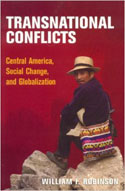
Transnational Conflicts: Central America, Social Change, and Globalization
by William I. Robinson
Reviewed by Jerry Harris

William Robinson is emerging as a major theorist on globalization, with particular expertise on Central and Latin America. His latest work, Transnational Conflicts combines innovative theoretical insights with a detailed empirical study of Central America. Any argument that positions U.S. hegemony at the center of a nation/state imperialist system will have to answer Robinson’s analysis of transnational capitalism.

What makes Robinson’s approach so unique is that he takes his argument into the heart of what most observers consider the backyard of U.S. imperialism, Central America. If any region of the world is under U.S. hegemony many would list the countries of this region: Guatemala, Honduras, El Salvador, Nicaragua and Costa Rica.

Read the Entire Review

Order this book from Amazon.com

Back to top